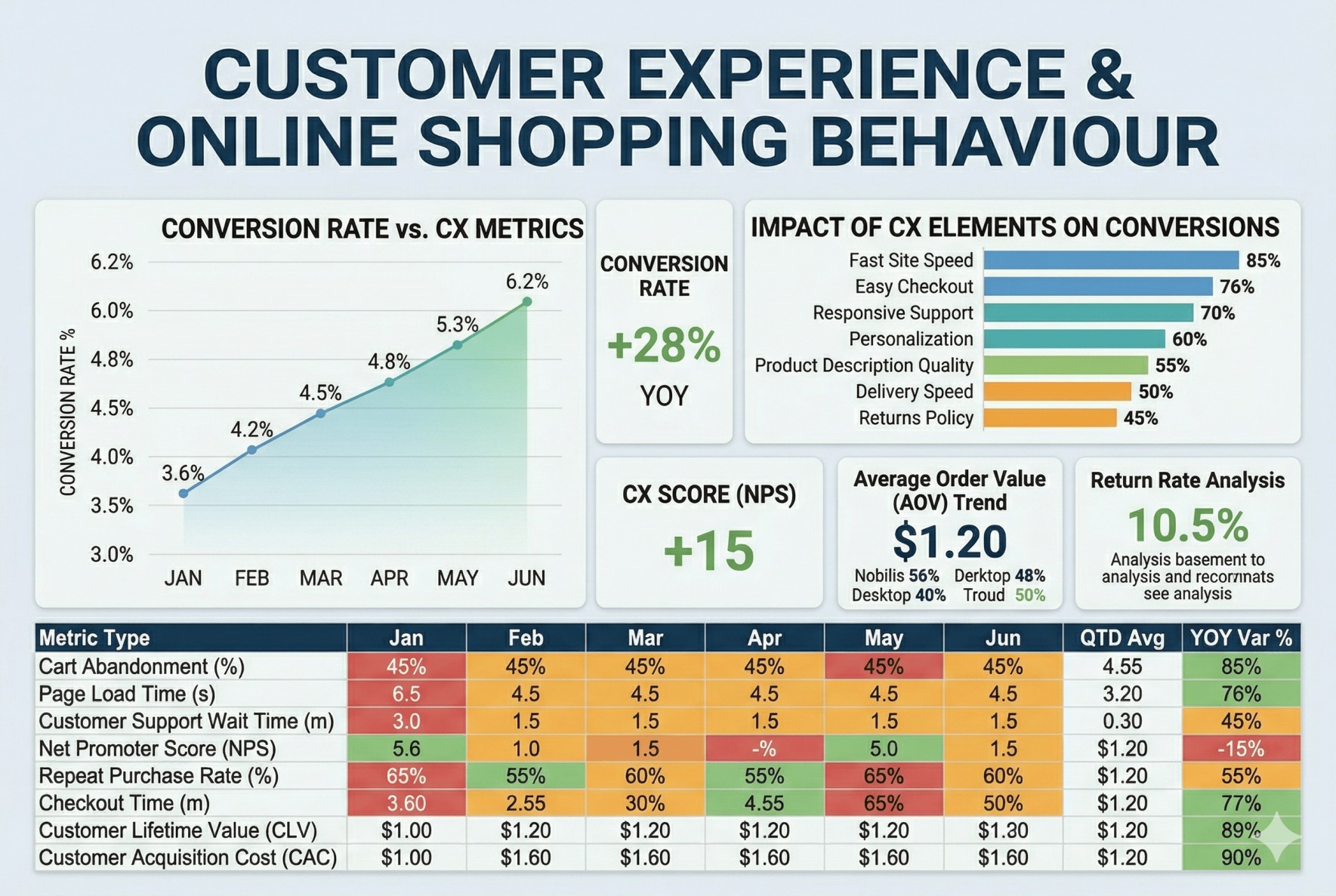
Customer Experience and Online Shopping Behaviour: How CX Impacts Conversions
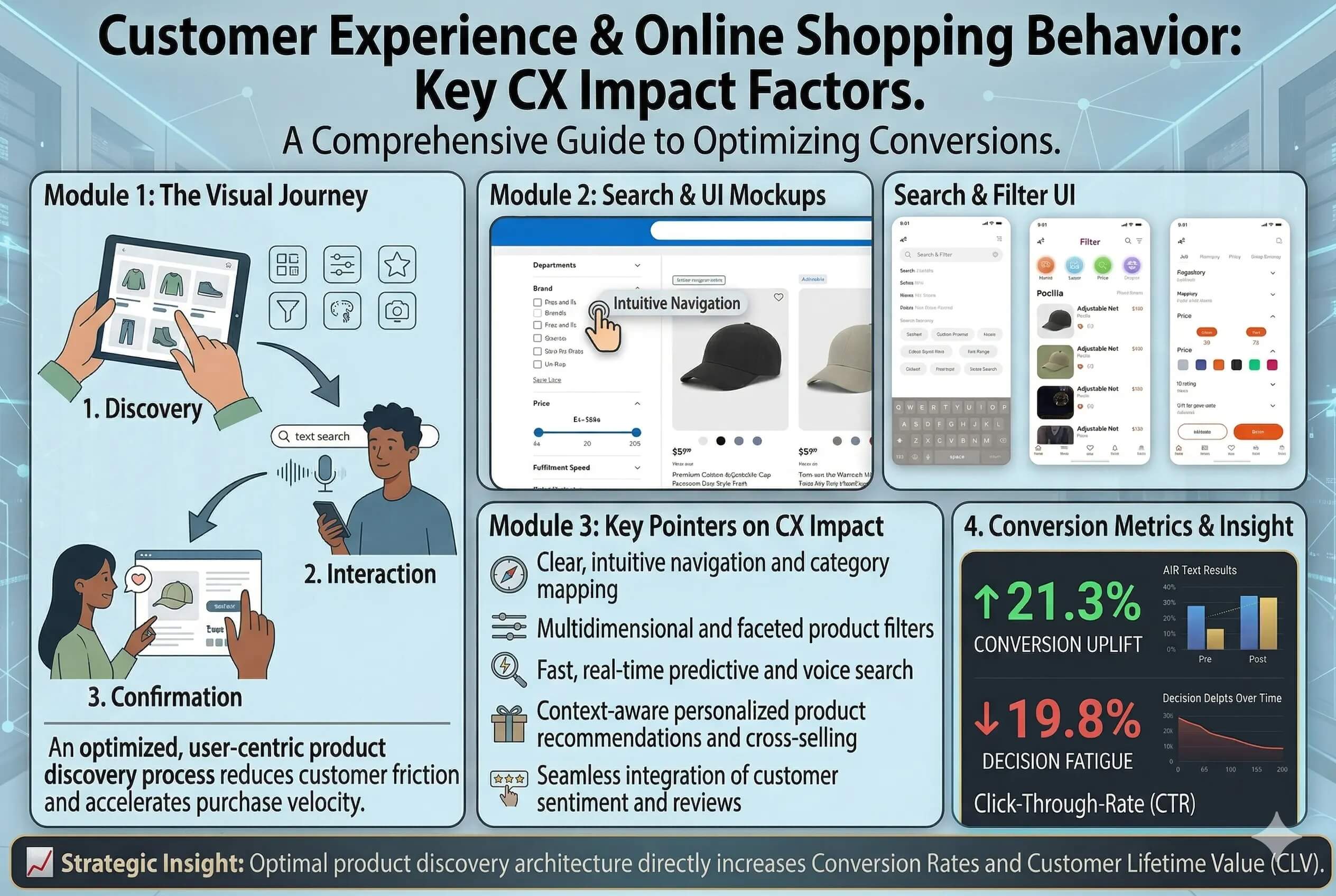
In the world of online shopping, products no longer win customers—experiences do. Over the past decade, I’ve seen a clear shift: brands that obsess over customer experience (CX) outperform those that focus only on pricing or product features. Today, customer experience is not just a support function; it’s a direct driver of conversions, loyalty, and long-term revenue.
Let’s break down how CX influences online shopping behaviour, backed by real insights, data, and practical understanding.
What is Customer Experience (CX) in E-commerce?
Customer experience refers to every interaction a user has with your brand—from discovering your website on Google to browsing products, making a purchase, and even post-sale support.
In e-commerce, CX includes:
- Website speed and usability
- Mobile responsiveness
- Product discovery and navigation
- Checkout process
- Payment flexibility
- Delivery and returns
- Customer support
A great CX feels effortless. A poor CX creates friction—and friction kills conversions.
Why CX Matters More Than Ever in Online Shopping
The modern customer is impatient, informed, and spoiled for choice. You’re not just competing with similar businesses—you’re competing with the best experience your customer has ever had.
Key Data Points:
- 88% of online consumers are less likely to return after a bad experience
- 70% of buying decisions are influenced by how customers feel they are treated
- A 1-second delay in page load can reduce conversions by up to 7%
- 86% of buyers are willing to pay more for a better experience
This tells us one thing clearly: CX is directly tied to revenue.
How Customer Experience Influences Online Buying Behaviour
1. First Impressions Decide Everything
Users form an opinion about your website within 0.05 seconds. If your site looks outdated, loads slowly, or feels cluttered, they bounce instantly.
A fast, clean, and mobile-optimized website builds trust immediately. This is why brands investing in Core Web Vitals and UX design see higher engagement and lower bounce rates.
Insight: Improving load time from 5s to 2s can increase conversions by 20–30%.
2. Navigation and Product Discovery Shape Purchase Intent
If users can’t find what they’re looking for within seconds, they leave.
Smart navigation includes:
- Clear categories
- Advanced filters (price, size, ratings)
- Predictive search
- Personalized recommendations
Amazon is a perfect example—it reduces decision fatigue and helps users reach products faster.
Insight: Sites with optimized navigation see up to 35% higher conversion rates.
3. Product Pages That Build Confidence Convert Better
Your product page is your salesperson.
A high-converting product page includes:
- High-quality images/videos
- Clear pricing and offers
- Detailed descriptions
- Customer reviews and ratings
- Trust badges and return policies
Data Insight: Products with reviews have 270% higher purchase likelihood.
Customers don’t just buy products—they buy confidence.
4. Checkout Experience: The Biggest Conversion Killer
Cart abandonment is one of the biggest issues in e-commerce. The average cart abandonment rate is around 70%.
Why does this happen?
- Complicated checkout
- Forced account creation
- Limited payment options
- Hidden charges
- Slow loading pages
Fixing checkout friction can dramatically increase conversions.
Insight: Offering guest checkout and multiple payment options (UPI, wallets, EMI) can boost conversions by 20–40%.
5. Personalization: The Game Changer in CX
Modern users expect brands to “know” them.
Personalization includes:
- Product recommendations
- Dynamic pricing/offers
- Email retargeting
- Recently viewed items
Netflix and Amazon have set the benchmark here.
Data Insight: Personalized experiences can increase revenue by up to 40%.
6. Mobile Experience is No Longer Optional
Over 70% of online shopping happens on mobile devices.
If your mobile UX is poor:
- Buttons are hard to click
- Pages load slowly
- Checkout is complicated
You’re losing a massive chunk of revenue.
Insight: Mobile-optimized sites see 2x higher conversion rates than non-optimized ones.
7. Trust, Security, and Transparency Build Loyalty
Trust is the backbone of CX.
Customers look for:
- Secure payment gateways
- Easy return policies
- Transparent pricing
- Authentic reviews
Data Insight: 81% of customers need to trust a brand before buying.
Without trust, even the best UX fails.
8. Post-Purchase Experience Drives Repeat Sales
Most brands ignore this stage—but it’s where loyalty is built.
A strong post-purchase CX includes:
- Real-time order tracking
- Easy returns/refunds
- Quick customer support
- Follow-up communication
Insight: Increasing customer retention by just 5% can boost profits by 25–95%.
The Direct Link Between CX and Conversion Rates
Let’s simplify the connection:
Better CX → Lower friction → Higher trust → Faster decisions → More conversions
Poor CX → Frustration → Drop-offs → Lost revenue
This is why companies investing in CX see consistent growth without increasing ad spend.
CX Metrics That Directly Impact Conversions
If you want to improve CX, track these:
- Bounce Rate
- Average Session Duration
- Cart Abandonment Rate
- Conversion Rate
- Customer Satisfaction Score (CSAT)
- Net Promoter Score (NPS)
These metrics tell you where users are struggling—and where you’re losing money.
Real-World Example: CX Improvement = Revenue Growth
One of my clients (mid-size e-commerce brand) was struggling with conversions despite high traffic.
Issues Identified:
- Slow mobile speed (6+ seconds load time)
- Complex checkout
- Poor product descriptions
Changes Implemented:
- Optimized images and speed (reduced to 2.5 seconds)
- Simplified checkout (guest + fewer steps)
- Improved product pages with reviews
Results:
- Conversion rate increased by 38%
- Bounce rate dropped by 25%
- Revenue increased without increasing ad spend
This is the power of CX.
Future Trends in Customer Experience and E-commerce
The next phase of CX will be even more advanced:
- AI-driven personalization
- Voice commerce
- Augmented reality (AR) product previews
- Chatbots with human-like interactions
- Predictive shopping behaviour
Brands that adapt early will dominate conversions.
How to Improve Customer Experience for Higher Conversions
Here’s a practical checklist you can implement:
- Optimize website speed (under 3 seconds)
- Simplify navigation and product discovery
- Improve product pages with real data and reviews
- Reduce checkout friction
- Offer multiple payment options
- Focus heavily on mobile UX
- Build trust with transparency
- Strengthen post-purchase experience
- Use personalization intelligently
- Continuously test and optimize (A/B testing)
Final Thoughts
Customer experience is no longer a “nice-to-have”—it’s the core of online success.
If your CX is strong, conversions follow naturally. If it’s weak, no amount of ads, SEO, or discounts will save you.
The brands winning today are not the ones selling the cheapest products—they’re the ones delivering the smoothest, fastest, and most trustworthy experiences.
And in e-commerce, experience is the real product.
FAQs
1. What is the role of CX in e-commerce conversions?
CX reduces friction, builds trust, and improves user satisfaction, directly increasing conversion rates.
2. How does website speed impact CX?
Faster websites improve user experience and can increase conversions by up to 20–30%.
3. Why is checkout optimization important?
A complicated checkout process leads to cart abandonment. Simplifying it improves conversions significantly.
4. How does personalization affect online shopping?
Personalization enhances relevance, leading to higher engagement and up to 40% more revenue.
5. What is the most important CX factor?
There is no single factor—speed, usability, trust, and support together create a strong CX.